
The Deistic Option
If our society as a whole is directionless, it is because we have abandoned many of the defining stories of our past without finding adequate replacements.
— Daniel Taylor, Tell Me a Story
The quote by Taylor is insightful. As the Western World began to supplant and tear down the Christian Theist view, the alternate views struggled to find adequate replacements for many of the ideas and concepts that were cast aside. Worldviews, just like nature, hate emptiness. When something is removed, another thing will take its place. When one idea is removed, another will take its place.
In the 1700s, Deism began to challenge the basic Theistic worldview. With the coming of the The Enlightenment in Europe, the concept of Revelation was largely rejected.
The Enlightenment is the intellectual movement that grew during the 1700s that held to the idea that better people and better societies could be shaped through the 1) use of reason, 2) the scientific method, and 3) the hope of technological progress. Generally, Enlightenment thinkers believed that nothing should be accepted on faith and that everything should be examined through a critical, secular (non-religious) viewpoint.
All the way back to the works of Thomas Aquinas (1225-1274) there was a debate about the relationship of Revelation and Natural Theology (Human Observation and Reason) as sources of knowledge about the World. In the following years, these two sources of truth were considered valid sources, but Revelation held dominance over Observation and Reason as the Ultimate Source of Truth.
With the coming of The Enlightenment, the Bible was challenged as an inspired, infallible communication from God – a position held up to that point by most Christian Theists. The question is then raised: “If the Bible is not “The Word of God,” then can we be sure we have ever heard from Him at all?
Deism makes the argument that observation of the natural world processed through human reason is sufficient to establish the existence of a Creator or at least a Supreme Being. Nevertheless, the Deists rejected the idea that this Creator had communicated with us. We no longer need the Creator or the Supreme Being to speak to us directly, He has made us and the world in way that we can figure out things on our own.
Several logical entanglements follow this basic assertion:
- A rejection of all forms of supposed revelation, including the Bible
- A rejection of the incomprehensible notion of the Trinity
- A rejection of anything “miraculous” or “prophetic”
In Theism we have the possibility of God’s speaking to us – Revelation – which opens the door to transcendental truths and hope. Within Deism we are left with our own observations of the data of the world and since there are no objective guideposts, these observations have tended to lead to despair.
In essence, Deism was a revival of Greek Epicureanism which taught that the gods had formed the world but then abandoned it to its own course. Deism affirms the existence of a Creator, but one who has abandoned his creation to its own devices.
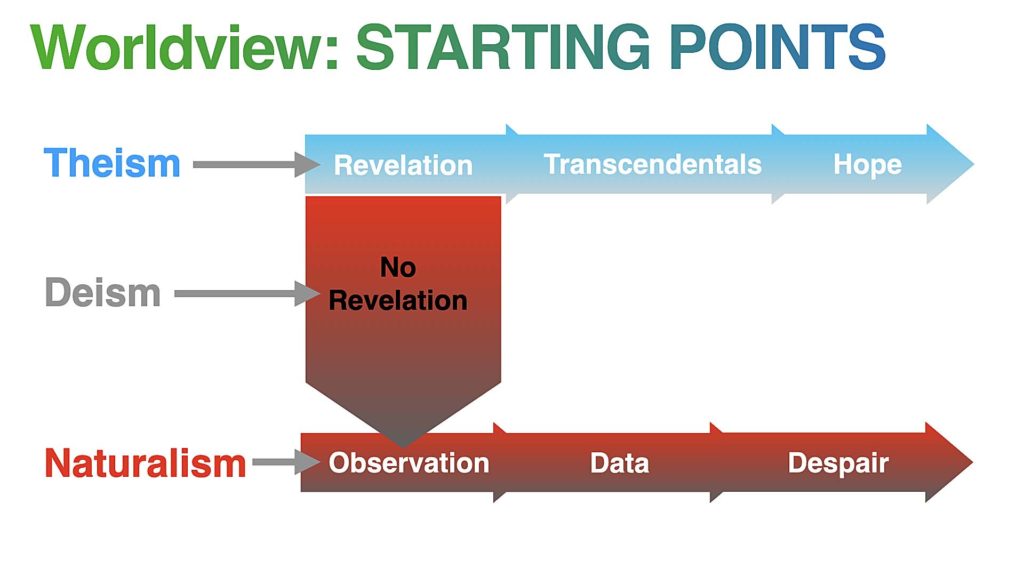
The Theistic view of the universe shaped and enchanted by the Truth, Goodness, and Glory of God gave way to the Deistic disenchanted, orphaned universe.
This paved the way for Naturalism which would be bolstered by the modern sciences.