
Bridging the Gap: From Modern to PostModern
From the tribe of Issachar, there were 200 leaders with their relatives.
All these men understood the times
and knew what Israel should do.
1 Chronicles 12:32
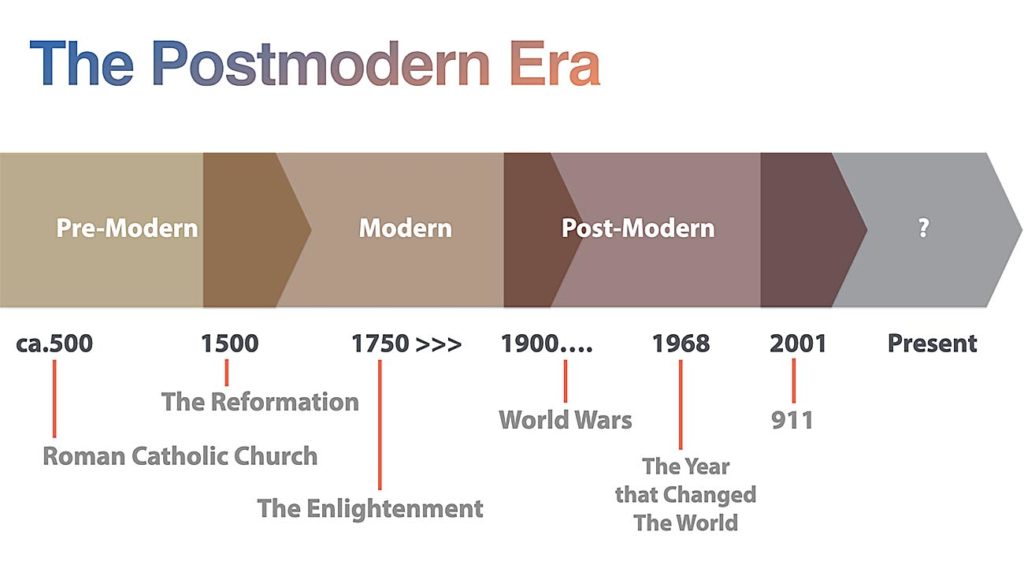
In order to understand the larger context of these worldviews, we need to understand the history that produced them. As we have already discussed, Culture and Tradition play a key role in shaping our view of the World and passing those views along through the generations. Ideas have consequences. And consequences have ideas that produced them. Understanding the “spirit of the times” (Zeitgeist) that has produced the key ideas of every worldview is essential in understanding the significance of that view.
We will present these eras in terms of four questions:
- Who or What defines Reality?
- Who or What defines what is True, Good/Righteous, and Beautiful?
- How do we know what we know?
- What can can give humanity hope?
The Pre-Modern (ca. 500 to 1500)
There is much debate about who these different ears should be delineated. For our purposes, we are going to begin the Pre-Modern Era with the emergence of the Roman Catholic Church in the Western remnants of the Roman Empire and end it with the philosophy of Rene Descartes.
During this era, the existence of God – the God of the Bible – was accepted as the ultimate source of reality. He was the seen as the Creator and Sustainer of all life. Most importantly, He had communicated with us – the Bible was His revelation.
Since God has communicated to us from the transcendent realm of eternity, His Word to us defined what was True, Good and Beautiful. Since the Bible was trusted as a Sacred Text, truly from God, we can know that what we know is real and true because there is an objective word from our Creator.
Some have described this era as being “enchanted.” The world was still largely mysterious and “filled with glory of God” but also inhabited by angels, demons and other unseen forces that were largely beyond human perception or control. The realm of the spiritual was accepted as a key part of reality, hidden just behind the veil of the physical world.
Hope in this era was linked to Father God sending His unique Son Jesus to save humanity from our sins and to ultimately establish His Kingdom in Creation. Our Creator had send a Savior who would in the end, be our King. The greatest problems that humanity faced were spiritual in nature and could only be healed spiritually.
However, during the middle and later stages of this era, the Roman Catholic Church defined itself as the mediator of all God’s graces and truth and thus there was “no salvation outside the church.” The institution of the Roman church became corrupted by power and greed. The church councils and their traditions were placed on equal authority with God’s World. From the 13th to the 16th Century, criticism and a call for reform became louder and louder. This eventually blossomed into The Great Reformation.
The end of this era was heralded by The Renaissance (“rebirth,” “revival”) in Southern Europe. In this transitional period, the philosophies of ancient Greece were rediscovered and the application of those ideas and ideals made a profound influence in art, architecture, politics, science and literature.
The Modern Era (ca. 1500 to 1900)
This period is best described as a period of great Revolution – a turning in the times. The early stages of this period has been referred to as The Enlightenment (1600s-1700s). The Renaissance also paved the way for massive shifts of The Enlightenment which was verified in the Scientific Revolution. In some sense, the “enlightenment” describes the net effect of this whole period, at least from a humanist perspective. Humanity had become enlightened by all of its current revolutions and so no longer need the old myths and superstitions, especially a god or sacred scriptures.
We begin this Era with two key figures: Martin Luther and Rene Descartes.
The Religious Revolution. Martin Luther was fire that set the Great Reformation ablaze. Although many had paved the way before him – Wycliffe, Waldo, Huss – Luther called into question the doctrines of the Roman church, charging that they were not coherent and consistent with the Truth of Scripture. Although the Reformers did not question the reality and relevance of God’s revelation, they did question and critique the Roman church’s interpretation of it.
In the Pre-Modern era, the Roman Church kept a tight reign on the Truth. The Bible was not available to the common person. The Bible during this era was a Latin translation not readily available in the common languages of Europe. Also, the Roman Church taught that “common people” were not equipped or able to interpret it properly. And so, the Roman Church simply told people what to believe.
After the Reformation, there was no longer a single institution – the Roman Catholic Church – which claimed to represent TRUTH, but many. The Roman Church was ultimately rejected by The Protestants as the infallible mediator and interpreter of God’s truth. The Reformers translated the Scriptures – from the Greek and Hebrew texts which had been rediscovered in the Renaissance – into the “mother tongues” of Europe: English, German, French….
Eventually, the Protestants fragmented into many movements and denominations: Baptist, Methodist, Prebyterian…. These divisions were all caused by the question of interpretation: “What do the Scriptures really mean?” Now that the Scriptures were open for all to interpret, there seemed to be as many different interpretations as interpreters. Correcting one major problem created another.
Beginning in the 18th Century, there would be a Revolution within Christianity in which scholars and philosophers challenged the idea of Revelation itself. The trustworthiness of the Bible would be called into question and many would promote alternative ultimate sources of knowledge and truth. That leads us to Descartes.
The Philosophical Revolution. During this era, Rene Descartes appears as the first “modern” philosopher. Before Descartes, philosophy/theology had dealt with the issues of what we know and what it means. Descartes famously became more interested in how we know what we know. In order to explore this question, he applied a method of almost radical doubt, asking himself, “What all can I doubt?” In the end, he could not doubt that he was doubting which is a form of thinking and so he comes to his famous conclusion: “I think, therefore I am.”
Descartes conclusion places knowing before being which we have discussed previously. Descartes had not come to this understand by trusting revelation but by trusting his thinking. This represents a massive shift. Human reason soon supplanted divine revelation as the basis for knowing.
Man is the measure of all things.
—Protagorus (490-420 BC)
The Scientific Revolution. This shift in epistemology – how we know what we know – coupled with the fruits of The Renaissance gave birth to the modern sciences. This explosion of observable knowledge gave us modern astronomy, calculus, modern physics and paved the way for the emerging of the great social sciences of the 19th and 20th centuries – sociology, psychology, anthropology. The publication of Isaac Newton’s Principia Mathematica in 1687 is often cited as the watershed event of this revolution.
Many of the early scientists and mathematicians were theists who considered their work to be simply explaining how the world worked. They did not see their work denying God and revelation, but rather supporting these realities. Nevertheless, those who would build on these foundation would eventually reject the very idea of revelation and further supplant it with observable evidence and provability verified by human reason.
One of the most massive shifts in this sphere of thought has to do with the essential nature and origin of the Universe. The Bible affirms that all that is physical has its origin in the spiritual – the essence of God the Creator. The modern sciences eventually concluded that there is no “spiritual” at all and so all that is left is physical, material. Therefore all our problems and hopes became founded in the material.
The most significant development during this era scientifically, culturally, and spiritually is that of Darwinism. Based on Charles Darwin’s studies and the publication of his The Origin of Species by Means of Natural Selection, or The Preservation of Favoured Races in the Struggle for Life, science began to embrace the idea that humanity was not the creation of God designed in His image, but the latest stage in animal evolution on the planet. Man was more akin to the monkey than he was to God.
In the advances of modern “ologies” – psychology and sociology – the human being became viewed as a complex biological machine. Humanity’s greatest problems were not spiritual (there was not evidence that any type of “spirit” actually existed) but chemical. Soon, there would be a drug to cure everything.
The Governmental Revolution. During the Pre-Modern Period, the Royal Monarchies which ruled countries were married to the power and influence of the Roman Catholic Church. The Pope held the keys to the Kingdom of Heaven and so all ultimately bowed to him. The Reformation exposed the Pope as a mere mortal. The revolutions of this era challenged both the “divine right of Kings” to rule and the ultimate authority of the Roman Church in political matters.
Rediscovered ideas from the old Roman Republic filtered through new democratic ideals gave birth to plans for Constitutional and Democratic Republics create “of the people, by the people, and for the people…” American threw off the old shackles of Imperialism and gave promise of a glorious “city set on a hill” with liberty for all (depending on how you define “all”). France soon followed, but with far more bloodshed and eventually a Reign of Terror.
The Industrial Revolution. This revolution came on the back, or maybe hand-in-hand, with the Scientific Revolution. This ushered in the age of mass production and the machines created to be the new servants of all humanity.
The promise of “science and progress” offered a world where a man could be free so that he (it was still “he” in this time – “she” had babies and kept the house) could be free to become a better person pursuing the “better life.”
This is a very compressed overview of this era, but we have said enough to establish the spirit of the Post-Modern Era.
To the question, “Who defines reality?”, the modern answer is: man.
To the question, “Who defines what is true, good, and glorious?”, the modern answer is: man.
To the question, “How do we know what we know?”, the modern answer is: because we are intelligent and reasonable enough to know.
And finally, to the question, “What can give humanity hope?” the modern answer is: science and technology.
In the modern era, human beings took control of our meaning and destiny. In the Post-Modern era, humanity would give itself a report card.
The Post-Modern Era (ca. 1900 to 2001)
When the foundations are being destroyed,
What can the righteous do?
Psalm 13:1
The foundation of the Post-Modern era is laid with Nietzche’s declaration: “God is dead.” The Revolutions of the Mechanized Modern era had transformed the enchanted universe of the pre-modern era into the disenchanted universe of the post-modern era.
The Modern Era did produce positive effects generally for those living in the West, particularly in terms of “standard of living.” The Enlightenment was a success in terms of insulting us from the brutality of the physical world and providing ways for Western cultures to thrive free from the threats of disease, hunger, and societal instability of previous eras. These things were still present of course, but the means were now available to counteract many of the worst effects of these enemies.
Spiritually speaking, The Enlightenment has proved to be an utter failure. The West has been left brutally ravaged after the murder of all things spiritual in The Modern Era. After tearing down the foundations built on the reality of God’s existence, His revelation to us, and the hope that He will “make all things new…” no one was able to rebuild with a better philosophical framework that gave meaning and coherence to culture and society, much less to the individual.
If our society as a whole is directionless, it is because we have abandoned many of the defining stories of our past without finding adequate replacements.
— Daniel Taylor, Tell Me a Story
Even if Science can’t prove or verify it, experience seems to show that men and women are souls with spirits that need spiritual nourishment just like the physical body need physical nourishment. This spiritual nourishment was once provided by the “living out”of the biblical Master Story in the context of a loving community to which one belonged. This belonging created meaning and purpose.
Secular psychology replaced theology as the means of thinking about the essential nature of the human being. The soul/spirit and “mind” became replace with the brain – a biological, chemical processing machine. Mental problems are chemical problems and can be cured by the right drug prescription.
Because the Master Story of Science rooted in Evolution is basically a hopeless story. We are here because we are here – we accidentally won the role of the cosmic dice. There is nothing larger or more glorious than that. The story of our being “fearfully and wonderfully made” was replaced with an empty and unsatisfying story of our evolution from the great nothing of primordial protein soup for no purpose.
In the present, it is extremely difficult to find meaning and purpose if the “Cosmos is all that is or was or ever will be.” There is nothing “eternal” about us. We are nothing more than specks of carbon, sparking on the scene and disappearing quickly in the vast flow of the Cosmic dream. We are personally disconnected from our past and there is no hope for our future in this Modern Master Story. The Modern World is one in which the human soul has no home.
The Industrial and Scientific Revolutions did provide many benefits – air conditioning and grocery stores being chief among them. They also created inhumane factories and child labor. When the internet goes down or the power goes out briefly, we can lay on our couch eating chips and complain about how bad we have it.
World War I was the first catastrophe that called into question the modernist hope in the upward progress of humanity. The belief in the inherent goodness of humanity was literally incinerated in the ovens of the concentration camps in Eastern Europe during World War II.
The possibility of human perfectibility gave way to war, racism and unspeakable human atrocity. Take note of the second title of Darwin’s original publication of Origin of the Species: or The Preservation of Favoured Races in the Struggle for Life. Almost everyone now leaves that title out. If evolution truly exists within humanity, then some “races” must be more advanced than others. This “scientific fact” reinforced the rational basis for race-based slavery in the modern era and the foundation for the genocidal policies of several 20th century governments: the Stalinists and Communists in Russia, the Nazis in Germany, the Khmer Rouge in Cambodia – the list goes on…
Technology had not paved the way for the “better life” as the moderns had hoped so much as it had made possible the weapons of mass destruction – the Golden Age gave way to the Nuclear Age. Hope for the future turned only to despair. If we did not obliterate ourselves in a nuclear holocaust, we would absolutely be exterminated by one of the newly emerged viruses.
Well the first War of the Machines [World War 2] seems to be drawing to its final inconclusive chapter – leaving, alas, everyone the poorer, many bereaved or maimed and millions dead, and only one thing triumphant: the Machines. As the servants of the Machines are becoming a privileged class, the Machines are going to be enormously more powerful. What’s their next move?. . . .
—J.R.R. Tolkien, The Letters of J.R.R. Tolkien, 111
The individualism of the Modern Era lapsed into the collectivism that defines much of the 20th century. The rise of Socialism, Fascism, Nazism, and Communism put an end to the pipe-dreams of liberty and freedom for all that was the great hope of the modern experiment.
Man is not autonomous as the moderns had hoped, instead he became one more wheel in the Machine, one among many – a producer of goods and services that would be enjoyed by the 2% who held 98% of the wealth.
The personnel office of a previous generation was replaced by the human resources department linguistically signaling the reality that is: the individual is a producer of goods and services and once the resource of the individual was used up by the 2% who already held 98% of the wealth, he or she would be “retired” or “terminated.” Resistance is futile, you will be consumed.
Living with others for the benefit of all, has been replaced by pursuing the “American dream” of acquiring individual success and wealth. This in turn has put a great strain on all forms of relationship. Since we have forgotten how to live with other humans, we pour more of our time and energy into unfulfilling jobs which leads to more alienation at home, among friends, etc. And so the spiral into despair continues ever downward.
Finally, in 2001, the demolition of the World Trade Towers in New York by Terrorists showed that not everyone envied the American ideal. Our disenchanted universe is also a disenchanted world where division and hatred and brutality still thrive.
“Whither is God,” [the madman] cried.
I shall tell you. We have killed him – your and I.
All of us are his murderers….
But how have we done this….
Who gave us the sponge to wipe away the entire horizon?…
How shall we, the murderers of all murderers, comfort ourselves.
—Friedrich Nietzche, “The Madman”
In postmodern times, hope has not died;
it has been willfully murdered.
Try as they might, The Modern Revolutions never gave an adequate substitute for the Creator they “killed.” Science has failed to give an adequate explanation of life that gives it significance and meaning. Technology has made some aspects of life better, but it has also opened Pandora’s mythical box and there are real monsters that have been loosed.
Since the Modern Revolutions ultimately suppressed all forms of transcendental truth, the postmodern person is left to despair, pondering whether or not there is even such a thing as truth at all. It is in this malaise that PostModernism was birthed in the second half of the 20th Century.
If all the traditions and structures that were trusted to give meaning and purpose to life have failed, is there anything left?