
How Do We Process Our Experience?
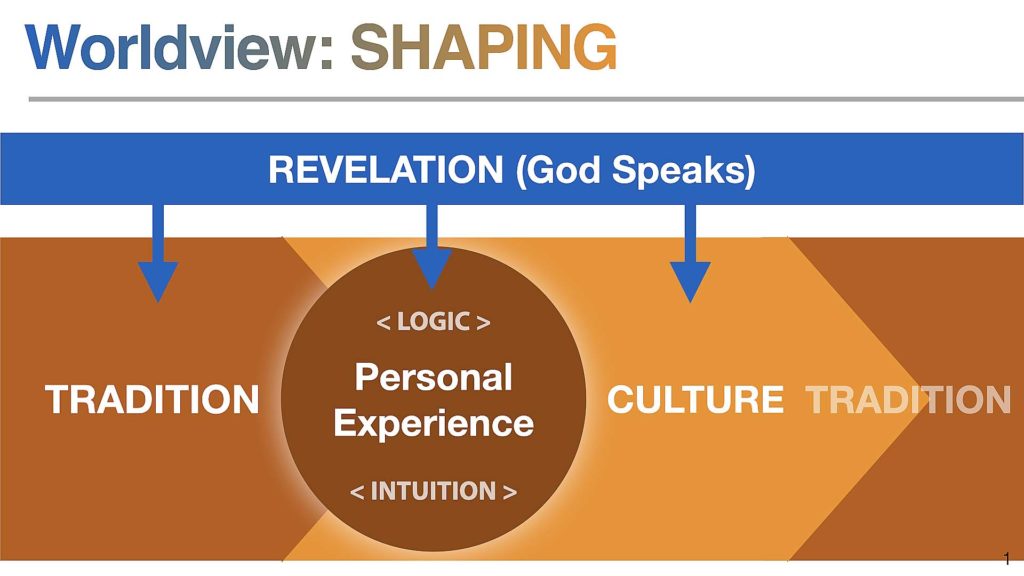
By now, you may realize that your experience can never establish the truth and is far too small to define transcendent truth. You may even misunderstand or misinterpret your own experience. Now, we will take a look at the “tools” that we use to evaluate and make sense out of all these things.
< Intuition >
Have you ever had a feeling something was just not right? Or have you ever felt that you needed to do something although you didn’t know why? This is intuition. Intuition is the ability to know something without reasoning it out analytically. Intuition is the ability make a decision or come to a conclusion without knowing all the reasons that are guiding you. We often become more intuitive the more experience we have with something.
In recent years, even neuro-science is showing that we process the world with more than our brains. Our whole bodies were created to interact with and respond to the world, sometimes with perceptions that are not formed in our conscious thoughts. We also now know that the left and right hemispheres of our brains work very different ways. Jim Wilder, who has written much on his work as a “neurotheologian,” calls the Left Side of the brain the “slow track” and it works at the speed of language – conscious thought. Wilder calls the Right Side the “fast track” and it works faster than our consciousness, or as Wilder puts it, “it works at the speed of joy.” We’ll have more to say about this later.
The ancients often associated the “guts” with emotion and intuition. A common saying in our times is “trust your gut!” If something seems or feels wrong, it may be. I have constantly encouraged my daughters to “listen to their guts.” We don’t always have to “trust our gut,” but if ignore it, we may be opening ourselves up to trouble.
Intuition can be a proper way to respond to our experiences IF we have enough life experience to do so! That is its real weakness. Since intuition depends on the amount of experience we have in the world, the less we have experienced, the less we can trust our intuition.
< Reason >
Reason is the term I am using to refer to the set of skills we use to think—to process information, ideas, and images. It encompasses logic, rationality, analysis, and language. Used properly, reason guides us in proper thinking, and it provides a check and balance to our intuition.
However, we must also be aware of reason’s weaknesses. We will outline them now in terms of four “gaps.”
The Ignorance Gap
We do not possess COMPLETE KNOWLEDGE of anything. We cannot even comprehend all that our brains are processing at the subconscious or preconscious level. Our reason is inherently flawed by the fact that we cannot know everything that is necessary to know in order to comprehend some things fully and properly.
The Inclination Gap
We are almost never impartial. In fact, the way we view the world has already been biased by our tradition and culture.
Arguments follow from assumptions, and assumptions follow from beliefs, and very rarely – perhaps never – do beliefs reflect an agenda determined entirely by the facts. No less than the doctrines of religious belief, the doctrines of quantum cosmology are what they seem: biased, partial, inconclusive, and largely in the service of passionate but unexamined conviction.
—David Berlinski, The Devil’s Delusion, 103-104
The Intelligence Gap
Our thinking about the world can simply be flawed because we are not thinking properly, our reasoning may be warped. The greatest flaw in our thinking is thinking that we have no flaws in our thinking.
What is worse, we may not be as smart as we think we are. Sometimes, the more “intelligent” people think they are, the more they are able to think themselves into trouble.
Though it always comes as a surprise to intellectuals, there are some forms of stupidity that one must be highly intelligent and educated to achieve.
—J. Budziszewski, “Escape From Nihilism”
There are principles of logic and reasoning that have been tested and proven. Learning critical thinking skills and problem solving is an important part of testing and approving our view of the world and our place in it. But logic can only take us so far.
In the end, we are all trusting someone who knows more than us to lead us in some aspects of our lives.
The Imagination Gap
This last one is tricky. There are two traps to fall into: 1) you have too much imagination, or 2) you have too little. Imagination – the ability to “see with your minds eye” or to form images based on thoughts in your mind – is an essential process in becoming a mature human being.
Some, however, let the imaginations run wild. The human mind is a meaning making machine. Given basic patterns, we will fill in the gaps to create meaning where there may not be any. One of the best examples of this is a phenomenon called pareidolia in which people see faces or familiar things in a random or ambiguous visual pattern. Finding shapes in clouds is an example of this ability. But, the next time you see the face of Jesus in the brown marks on your toast, you might want to take another look.
The other problem with imagination is that sadly for many in our times, it has not been developed properly. Our “visual culture” tied to screens and video has wrecked our imaginations. Reading cannot be done properly without a healthy imagination. This can become a circular problem because reading is one of the key ways we train our imagination.
The key pathology of our time, which seduces all, is the reduction of the imagination so that we are too numbed, satiated and co-opted to do serious imaginative work.
—Walter Bruggeman, Interpretation and Obedience
So, to say it over simply, we want to learn how to use our reason and intuition properly and correct any short comings with may have in our “gaps” of understanding.
Next, we will see how Christ can help us in all these areas.