
How Is Your Worldview Formed?
Reason is itself a matter of faith. It is an act of faith to assert that our thoughts have any relation to reality at all.
― G.K. Chesterton
We each have a unique personal experience of the world—each of our lives has its own unique story-line. Experience can be defined as the sum total of all events that a person has participated in or lived through which shapes his/her personality, attitudes, beliefs, etc. Everything we are and do is a process of our experience, from driving a car to studying the Bible. Experience is our individual frame of reference for life.
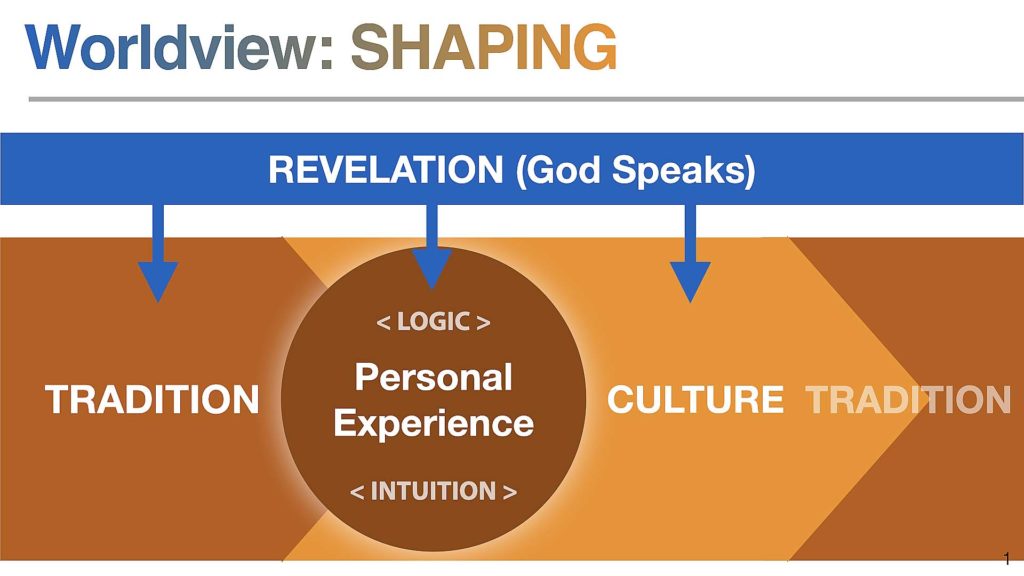
Our experience of the world and in the world is shaped by our sources of knowledge. These sources influence and shape the way we think about and process the world and our place in it. These influential sources shape and form the “lenses” through which we see the world. If we can names these sources and understand how they influence us, we will be better equipped to analyze the way in which we view the world.
As we think about and process our own experience, we want to know that our worldview is in line with reality—what is really real. We want to know that our experience is shaped by truth. So how do we know that what we know is true? How can we know that our sources of knowledge about the world are trust-worthy?
The first step in answering these questions is to understand what these sources are and how they work. We are going to consider three of these sources and influences: tradition, culture, and revelation.
These sources often compete with one another to pull our beliefs and commitments toward their gravitational center. As we begin to think about our own worldview more critically, it is important to realize that a healthy and clear worldview will always strive for a proper balance of these factors. Not seeing them in their proper relationships with one another will skew our view of the world, and ultimately our understanding of truth.
To understand these influential sources, we must define them and take a brief look at their strengths and weaknesses.
Source 1: Tradition
If you don’t know history, then you don’t know anything. You are a leaf that doesn’t know it is part of a tree.
—Michael Crichton
A generation which ignores history has no past – and no future.
—Robert A. Heinlein
Tradition is a history of past events, decisions, beliefs that are shared in common within a certain group of people. Tradition may be the most powerful influence shaping the way we view the world. If you think about it, you are born into a certain family, in a certain place, at a certain time. There was a history of people and events that shaped all of these long before you were born. You were born into a net of traditions.
Tradition is a positive influence because the past helps us to understand the present by telling us where we came from. Tradition also provides balance to the force of culture which tends to focus on the “here and now.” Tradition, however, may become too authoritative and crowd out all other alternatives. Tradition is always pulling us toward “the same ol’ things” which might lead to stagnation. Tradition wants to teach that the oldest answers are always right, but this is not always true.
Source 2: Culture
Culture is what we make of the world.
—Andy Crouch)
Culture is the collective of beliefs, behavior patterns, habits, arts, institutions, and all other products of human work and thought at a given period in time among a specific people group (an “in crowd”). Culture can encompass something as large as a country or nation, or be as small as a club of hobbyists or like-minded people. Culture is the way we express ourselves in our larger “in group” and also enjoy and celebrate our shared experiences as humans.
It is important to remember that culture, in one sense, is a product of God’s creation of humanity. We were created to live in community with one another, working and creating together. The Bible shows that God communicated in and through culture, not in spite of it.
Culture, if interpreted properly, can bring balance to tradition as it realizes that history is moving forward and change is necessary. Culture is generally pulling us toward innovation. However, just like tradition, culture can become too authoritative in terms of defining what is accepted as “true.” Contrary to popular opinion, the newest answers are not always right or best.
* In time, accepted culture becomes tradition. Let me say that again because it is very important: today’s culture is producing the tradition of the future.
Source 3: Revelation (God Speaks to Us)
Long ago, at many times and in many ways,
God spoke to our fathers by the prophets,
but in these last days
He has spoken to us IN HIS SON …
—Hebrews 1:1–2
The last source of knowledge is Revelation. All this means is that the Lord God who created us has revealed Himself to us and has communicated with us. If you think about Tradition and Culture, both of these sources may simply be human beings communicating and sharing with one another “inside” the boundaries of time and space, in creation. Without revelation, tradition and culture are only products of our human observations and evaluations of life from inside the “box” of personal experience.
But if “God is there and He is not silent,” to use Francis Schaeffer’s phrase, this would mean that He is speaking to us from the “outside.” And if He is our Creator, then He would have the best perspective on our world, free from the “box” of time and space.
This knowledge that comes from the “outside” is what we call transcendent knowledge or truth. This is Truth—with a capital T—that exists above and beyond all traditional or cultural influences. In the Western world, until the time of the so-called Enlightenment, Transcendent Truth was thought to be synonymous with The Bible, The Scriptures—the inspired and infallible Word of God given to us in human language.
The Scriptures, then, are actually a part of Christian Tradition. For those who believe the written Scriptures are the Word of God, they see the Bible as a supremely authoritative source of tradition: what God has spoken in the past is still relevant for the present and the future. For those who view the Scriptures this way, The Bible is the traditional text that becomes the standard of truth and goodness for everything else.
Not everyone believes in revelation. Many now believe and affirm that the only true knowledge we have is what we can observe about life using our own senses. And even among people who believe that the Bible is a revelation from Creator God, there is often disagreement about what the Scriptures mean and how they should be applied.
If, however, we take the Bible to be a revelation from our Creator, then we have access to knowledge that is not available to us through mere observation. Because He is transcendent (above and beyond all other things) and personal (He has made Himself know to us) there is a Truth that stands above time and space and ultimately beyond humanity’s ability to manipulate.
Next, we will explore how we process all of this.