
Thinking Deeply About Media

Not all media are created equal. Cultural critics and media ecologists like Marshall McLuhan, Neil Postman, and Walter Ong have warned that with every advance that comes through some technological means, there is always a price to be paid. The following story from Plato is classic illustration of this very point:
The Judgment of Thamus
At the Egyptian city of Naucratis, there was a famous old god, whose name was Theuth; the bird which is called the Ibis is sacred to him, and he was the inventor of many arts, such as arithmetic and calculation and geometry and astronomy … but his great discovery was the use of letters.
Now in those days the god Thamus was the king of the whole country of Egypt… To him came Theuth and showed his inventions, desiring that the other Egyptians might be allowed to have the benefit of them. He enumerated them, and Thamus enquired about their several uses, praising some and censuring others, as he approved or disapproved of them. It would take a long time to repeat all that Thamus said to Theuth in praise or blame of the various arts.
But when they came to letters, “This,” said Theuth, “will make the Egyptians wiser and give them better memories. It is a sure thing both for the memory and for wisdom.”|
Thamus replied: “O most ingenious Theuth, the parent or inventor of an art is not always the best judge of the utility or inutility of his own inventions to the users of them. And in this instance, you who are the father of letters, from a paternal love of your own children have been led to attribute to them a quality which they cannot have. For this discovery of yours will create forgetfulness in the learners’ souls, because they will not use their memories. They will trust to the external written characters and not remember of themselves. The thing which you have discovered is an aid not to memory, but to reminiscence. You give your disciples not truth, but only the semblance of truth. They will be hearers of many things and will have learned nothing. They will appear to be omniscient and will generally know nothing. They will be tiresome company, having the show of wisdom without the reality.
– Plato, Phaedrus, 360 B.C.E –
In commenting on this story, Neil Postman observes that for all its insight, it makes an error in only seeing the negative effects of writing without also seeing all of its benefits.
Every technology is both a burden and a blessing;
not either-or, but this-and-that.
– Neil Postman, Technopoly –
The discussion of how the different forms of media affect us as human beings is a large and complicated topic. The real danger is that most us never stop to think at all about how our many technological forms of communications are shaping us.
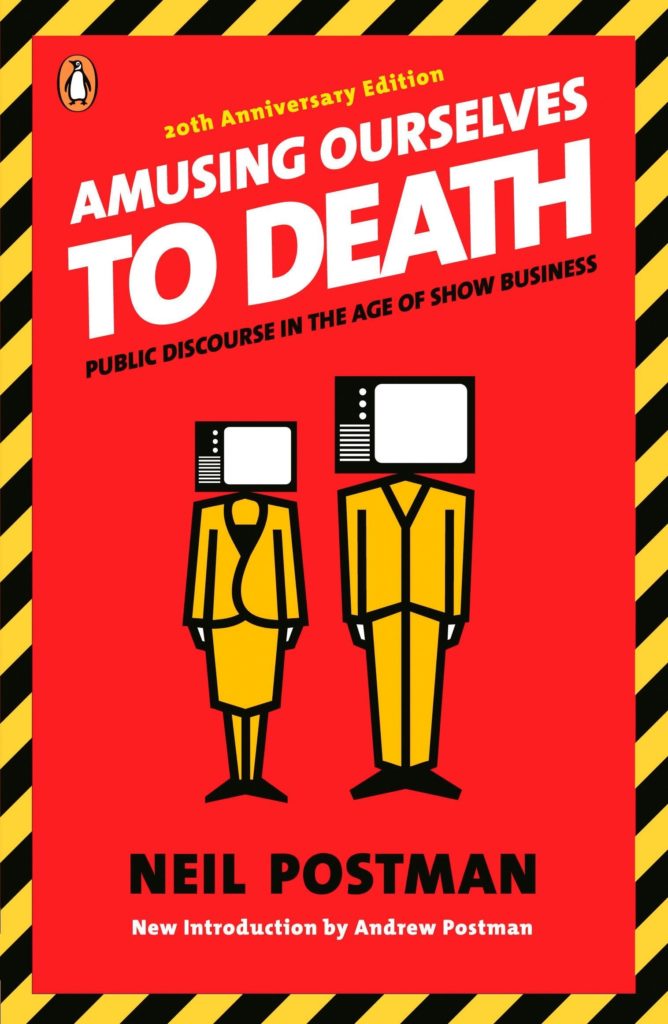
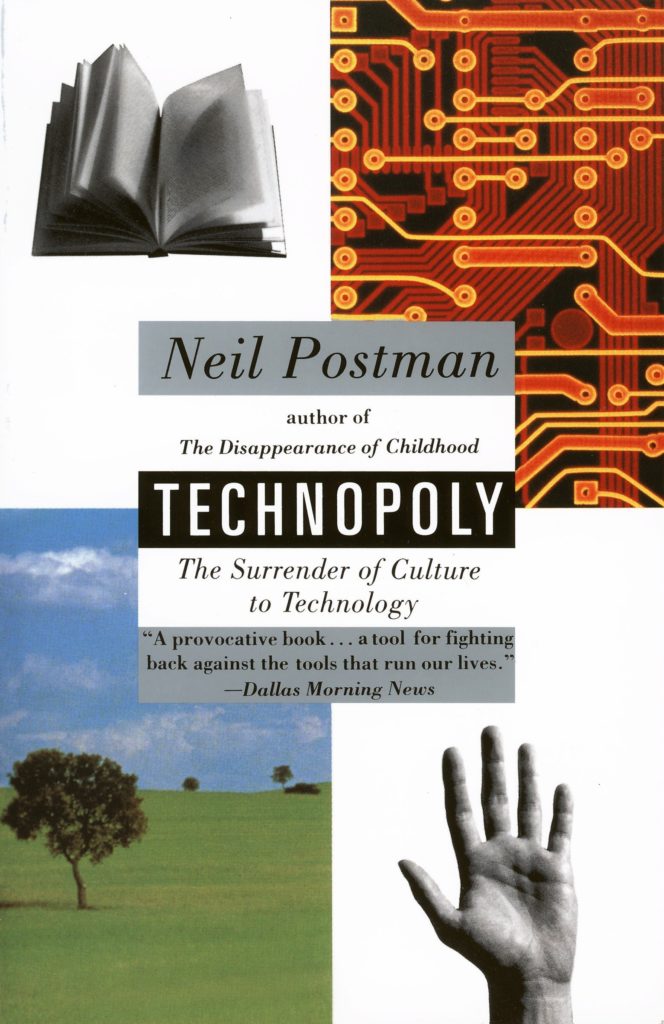
We will only skim the surface of some very important discussions. I would highly recommend you look into the works of Neil Postman. His works are an easily digestible introduction to this topic. His books Amusing Ourselves to Death: Public Discourse in the Age of Show Business and Technopoly: The Surrender of Culture to Technology are essential reading.
(Click on the images below to go to Amazon)
Evaluating What We See and Hear
In thinking about the media, the most important question that we raise is:
Who Do We Truly Trust?
Answering this question is not as easy as it once was. In pre-Modern cultures, the idea that God or the gods had communicated with us in some way was a valid option for finding answers and making sense of our world. Now in our Post-Modern, Secular cultures many of our mass media sources would have us believe that the very idea of a transcendent being or god is ridiculous. The vast majority of “common folk” would say otherwise.
For any society or culture to make meaning, it must have a Larger Story that makes sense of all the smaller stories that create reality. Once again, we are back to the idea of the importance of Master Stories. In our times, people are living in a vast array of very different Master Stories. These very different Stories create “alternate universes” of perception. The tools of Mass Media are used to reinforce and broadcast these perceptions.
We are inundated with facts, ideas, stories from a multitude of media sources. How should we think about these sources? And how can we evaluate them?
The Democratization of Media
The Internet, more than any other media technology that came before, has revolutionized the way we communicate and relate. And as we have just observed, what it has provided is both burden and blessing.
It used to be that all mass media and communication was controlled by a relatively small group of people in the TV and Radio networks. These people served as gatekeepers for all broadcast information, deciding what information would be shared. Producing programming for these formats was difficult and very expensive and so by its very nature was limited to those who could afford the cost of production.
The Internet coupled with digital videography and photography and ultimately smart phones and the like has made it possible for almost anyone to become a mass media producer. Facebook, Twitter, Instagram, Youtube and all the other emerging social media technologies have almost destroyed the ability for any small group to hold universal sway over the population. The decentralization of mass communication media has led to its democratization. We have shifted from a “one-to-many” oligarchy to a “many-to-many” democracy.
“What could be wrong with that?” we could ask. The Digital Revolution has blessed us with the ability to create and have access to information far more easily than any generation before us. BUT it has also burdened us with a far harder job of evaluating, assimilating and unifying all that is available to us.
There is no Larger, Master Story to make sense of all the information in the digital domain. Instead we have seen an increased tribalism develop around social media in which we gravitate toward those who are saying what we want to hear. The “echo chambers” or “filter bubbles” create incestuous feedback loops which divide and tear at fabric of our cultures. “Cancel culture” is also posing the greatest threat to the democratic hope of the digitally connected world. If our “in group” doesn’t like what you are saying, we will shut you down or shut you up.
The democratizing of mass communication is also tied very closely to the Worldview Element of The Priesthood (Experts or Masters) and Share Core Values which we will explore in our next sessions. It used to be that you needed to be a true expert or master of some field in order to be worthy of broadcasting. Now, anyone with a Facebook account or Youtube channel can claim expertise or mastery without proof or evidence. Trying to make a cake in a paper cup in the microwave based on a Youtube “quick tip” video can often quickly give empirical proof that our democratic digital domain is inhabited by a new form of “snake oil salesman.” Because the possibility of deception is amplified online, we must be all the more diligent to not become the “sucker” that is proverbially “born every minute” as P. T. Barnum allegedly observed.
With the staggering and mind-numbing amount of information now available, we are often paralyzed in knowing who and what to trust. Critically evaluating every story or fact that comes to us even in a single day is now impossible. As our culture and society becomes more and more dominated by digital communication networks we see people gravitate to the information that is most familiar and that they want to believe. Remember: we always believe what we want to believe and so we must take care to evaluate and understand our wants and desires.
From Revelation to The News
“Societies become modern . . . when news replaces religion as our central source of guidance and our touchstone of authority. In the developed economies, the news now occupies a position of power at least equal to that formerly enjoyed by the faiths . . . We approach it with some of the same deferential expectations we would have harbored for the faiths. Here, too, we hope to receive revelations, learn who is good and bad, fathom suffering and understand the unfolding logic of existence. And here, too, if we refuse to take part in the rituals, there could be imputations of heresy.”
– Alain de Botton, News: A User’s Guide –
It was not that long ago that 6pm was a sacred time in America – the hour that nearly everyone habitually gathered around the TV to get the “news.” The quote from de Botton above highlights again one of the major shifts from the pre-modern to the modern world.
Building on what we have just discussed under the democratization of media, now there are multiple sources for “news,” all coming from very different and often opposing viewpoints. Every source for “news” is overseen by the “gate-keepers” of that agency and no matter how unbiased anyone may claim to be, the very format of condensed, give-me-the-basic-facts, sound-bite reporting can never give the whole story or even everything that is relevant in whatever is being reported.
Fake News and False Media
So, the “broadcast news” is problematic. But we have another problem that complicates things exponentially. With the development of malicious botnets and emerging Artificial Intelligence applications which are used to create fake social media accounts, websites, and other online personas, it is becoming increasingly difficult to know what is real and what is unreal.
The Medium IS The Message
“Society not only continues to exist by transmission, by communication, but it may fairly be said to exist in transmission, in communication.”
– John Dewey in Democracy and Education, 1916 –
Almost every form of media today is driven and supported by advertising that seeks to sell products. When we use social media like Facebook, Twitter, YouTube (Google), or Instagram for free, we need to understand that we are the product – it is our attention and interest that is being sold to the advertisers.
When our face-to-face communication breaks, our relationships suffer. But when mass communication breaks down or becomes toxic, society disintegrates.